An Island That Can Sail Away
Most artificial islands are arguments with geography. You pump sand onto a reef, drive piles into a seabed, and then spend the rest of the project’s life defending what you have built against the water and against the people who dispute your right to have built it.
The Chinese platform now under contract does something different. It is an island that can weigh anchor.
On 20 October 2026, Shanghai Jiao Tong University signed the construction contract for its national major science and technology infrastructure project, formally called the Deep-Sea All-Weather Resident Floating Research Facility and informally the “Offshore Floating Island”. The builder is Shanghai Waigaoqiao Shipbuilding, part of China State Shipbuilding Corporation, which won the bid at 2.763 billion yuan — roughly $413 million. Construction is due to begin in 2028, with delivery scheduled for June 2030.
The specifications are the interesting part.
A city block with a propeller
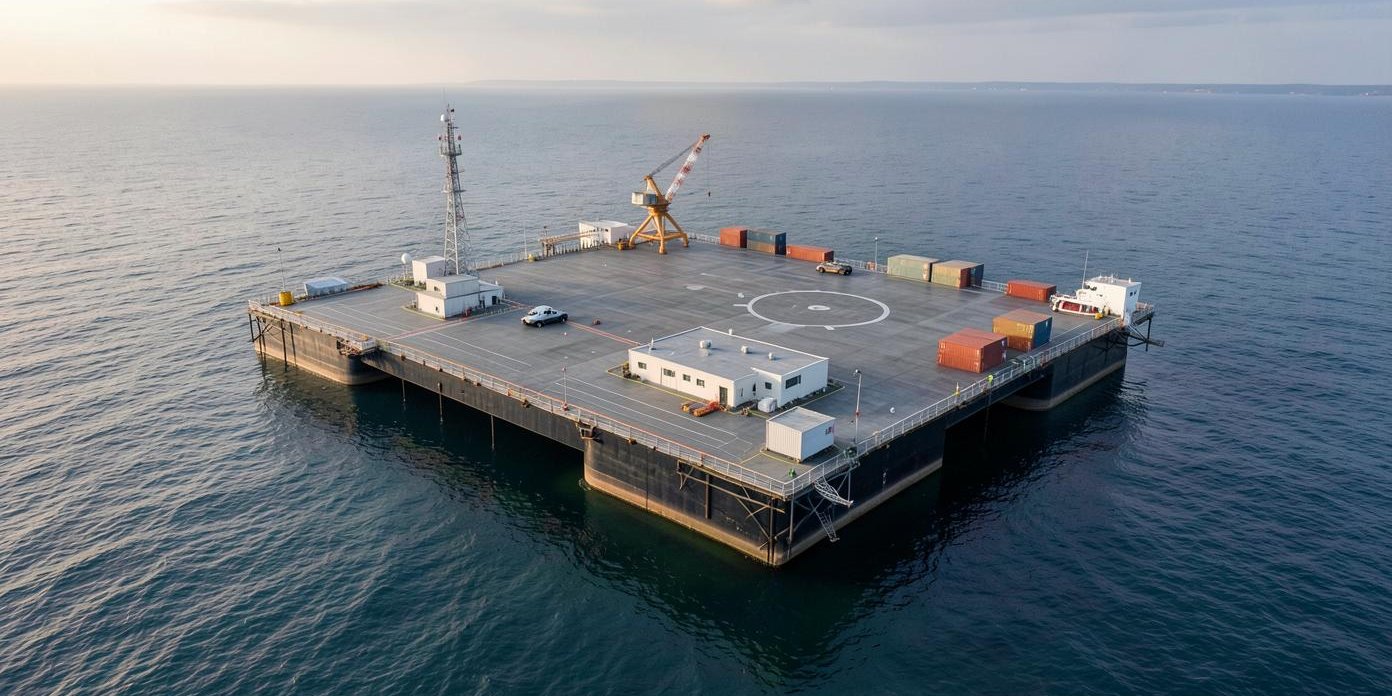
The platform measures 138 by 85 metres — a footprint of about 1.2 hectares, or a large city block — and stands on a semi-submersible twin-hull base. Its main deck sits about 45 metres above the water. Maximum displacement is around 74,000 tonnes, roughly the order of a large aircraft carrier, which is why early coverage reached for that comparison.
It is designed to hold position in Sea State 7, with waves of six to nine metres, and to survive a Category 17 typhoon with sustained winds above 265 kilometres per hour. Cruising speed is 11 knots.
Those two numbers — the survivable typhoon and the cruising speed — describe the entire concept. Most research vessels are built for one or the other. A drillship or a semi-submersible rig can ride out weather but has to be towed to a new location at the pace of a tug. A survey ship can go anywhere but must run for port when the weather turns. This platform is meant to sit in the open ocean for months and then move.
Aboard are six shipborne laboratories and an offshore operations support centre, supporting 238 crew and researchers. The labs are grouped around heavy marine equipment and systems technology, meteorological observation and research for marine disasters, and long-term monitoring of marine ecosystems. Land-based support hubs are planned at Changxing in Shanghai and Sanya on Hainan.
The stated missions are equally concrete: domestic development of high-end marine equipment, sustainable use of marine resources, marine weather forecasting and disaster mitigation, and research into the origins of deep-sea biodiversity.
The legal trick of staying a ship
Here is what makes the project more than a very large boat.
An artificial island is a fixed structure. Under the law of the sea it generates no territorial sea of its own, it sits within somebody’s exclusive economic zone, and its status is a permanent diplomatic negotiation. Reclaimed land is, by design, impossible to move and therefore impossible to abandon.
A self-propelled platform is a vessel. It sails under a flag, it is registered, classed and surveyed like a ship, and when it leaves it takes its laboratory with it. The “island” in the project’s nickname describes the experience of living there, not its legal condition. That is a deliberate and quietly significant choice: China gets the endurance and the footprint of a settlement with the legal flexibility of a ship.
This is the same discovery the seasteading movement spent two decades failing to make convincing. Floating cities proposed by libertarian entrepreneurs usually ran aground on the question of who would recognise them. A research vessel does not need to be recognised as anything other than a research vessel.
It is worth being precise about how much of this is new. Usha Haley, who studies international business strategy at Wichita State University, told Newsweek that the engineering is “less novel than the ‘island’ label suggests,” while “the scale, endurance, and mission are new.” She is right. Semi-submersible twin-hull platforms, dynamic positioning, heavy-lift decks and long-endurance research ships all exist. Nobody has combined them at this size for this purpose.
The settlement test
For readers of this site, the platform is interesting for a reason its builders may not emphasise.
Every floating city proposal of the last twenty years — the Maldives, Busan’s OCEANIX prototype, the various pontoon archipelagos — has been an exercise in civil engineering: platforms, hulls, moorings, utilities, housing blocks. What those projects have not yet produced is a place where people live for months at a time, far from land, doing useful work, with the systems to keep them alive and the logistics to keep them supplied.
That is precisely what a 238-person, all-weather resident platform with six laboratories is.
It is not a city. There are no families, no schools, no shops, no municipal politics. But the operational questions are the same ones a floating settlement would face: how to generate and store power at sea for months, how to treat waste in a closed loop, how to maintain machinery without a shipyard, how to keep a few hundred people occupied who cannot leave, and how to evacuate when the weather exceeds the design case.
The industry that answers those questions is not urban planning. It is offshore oil and gas, navies, and polar research stations.
This is the pattern worth watching. The first permanently inhabited places at sea will not be designed by architects. They will be commissioned by science ministries and built by shipyards, and they will look like infrastructure that gradually acquired residents — which is exactly how the last article in this series described the return of undersea habitation.
What could still go wrong
The project has four years of construction and a great deal of engineering ahead of it, and the usual caveats apply.
Cost estimates on national mega-infrastructure have a way of moving. The schedule — construction starting in 2028, delivery in 2030 — is brisk for a first-of-class vessel of this complexity. Station-keeping in a Category 17 typhoon is a design claim until it has been demonstrated. And the phrase “all-weather” carries a hidden operational cost: a platform built to survive the worst storm in the basin will be heavier, more expensive and less efficient on the ordinary days that make up most of its life.
There is also the question every large research platform faces after the ribbon is cut: whether the science programme is funded at the level the facility requires. A ship that can stay at sea for months is only useful if there are scientists, instruments and consumables to keep sending out to it.
None of that changes the shape of the thing.
For a century, the fantasy of the floating city has been drawn as a skyline: towers, domes, marinas, a new Venice. The version now being welded together in a Chinese shipyard is far less romantic and considerably more plausible. It is a deck, a hull, a weather forecast, and a decision about where to be next month.
An island you can sail away from is not a country. It may still turn out to be the first honest prototype of one.
Sources
- iMarine — Shanghai Waigaoqiao Shipbuilding wins contract for “Offshore Floating Island” deep-sea research platform, 21 October 2026
- The Maritime Executive — China to build self-propelled floating marine research island, 23 October 2026
- South China Morning Post — China formally launches project to build aircraft carrier-sized “science island”, 28 October 2026
- Newsweek — China’s giant “floating island” could spend months in the open ocean, 3 November 2026
Image: an artist’s impression of the platform based on published specifications.