Living Underwater Is Back
For most of the last half-century, living underwater has looked like a future that already happened.
Jacques Cousteau’s Conshelf experiments, the U.S. Navy’s Sealab programme, Tektite and later Aquarius all proved that people could remain beneath the sea for days or weeks. Yet the idea never developed into the network of permanent undersea stations that futurists once imagined. Humans went to orbit, built a continuously occupied space station and sent robots across Mars. The ocean floor remained somewhere we mostly visited.
That may be changing.
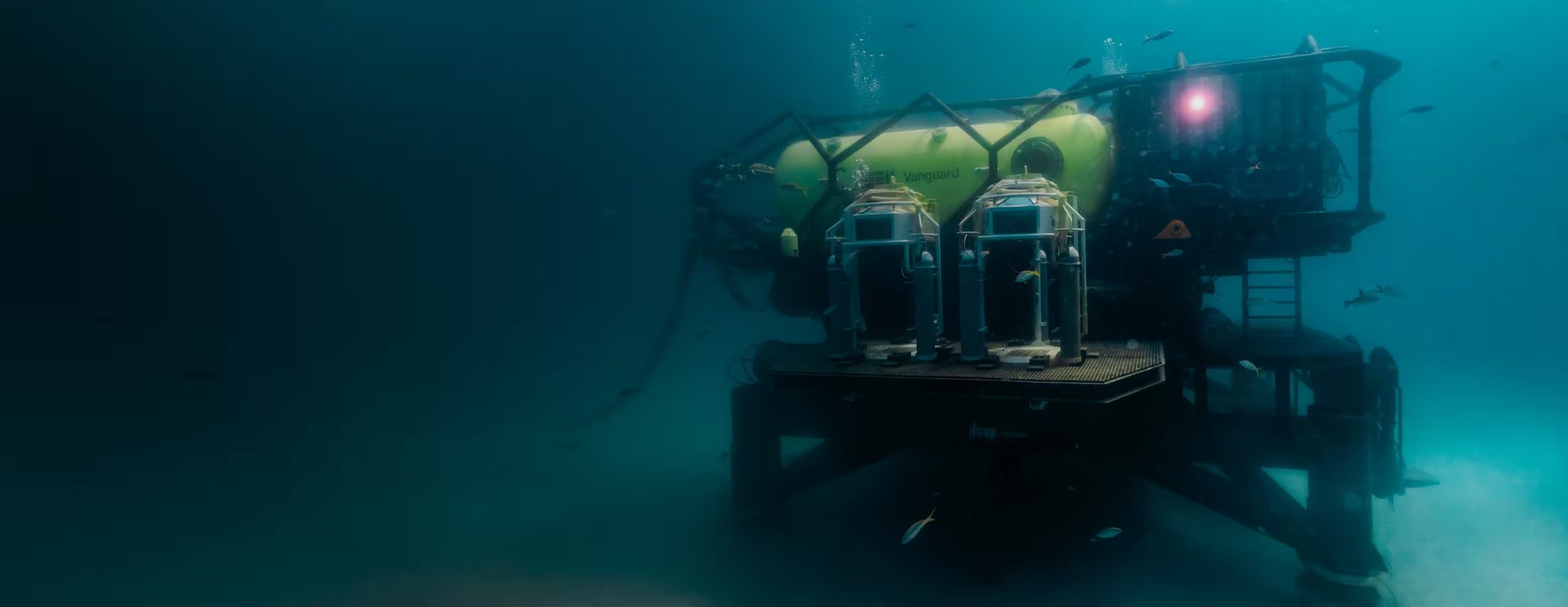
In June 2026, ocean engineering company DEEP installed Vanguard, a crewed subsea habitat, at Tennessee Reef in the Florida Keys National Marine Sanctuary. The system sits about 17 metres below the surface and is intended to support four people on extended missions.
At the end of September, Vanguard received an Interim Classification Certificate from DNV, allowing it to move into its initial operating phase. Crews can now begin extended-stay saturation operations while the habitat continues toward full classification.
This is not yet an underwater city. It is much more interesting than a rendering of one.
It is infrastructure.
A house at ambient pressure
Vanguard is a compact machine for making one small part of the seabed continuously habitable.
The habitat combines a dry living chamber with a dive centre and moon pool. A surface buoy supplies services including power, compressed air and communications. Its occupants can live at pressure and leave directly into the surrounding ocean.
The important idea is saturation.
On an ordinary dive, time at depth is constrained by the gases absorbed into the body and the decompression required on the way back up. In saturation diving, after enough time at a given pressure, the body’s tissues cannot absorb significantly more inert gas. Instead of repeatedly travelling between surface pressure and depth, aquanauts stay down and decompress only once, at the end of the mission.
That changes the geometry of work.
A scientist no longer travels from a distant laboratory to the reef, works for a limited interval, then returns to the surface. The laboratory moves to the reef.
NASA has used the older Aquarius habitat for the same reason in its NEEMO missions: living underwater creates an isolated, high-consequence environment where crews can test procedures and technologies for space exploration. Underwater habitation is therefore an unusual branch of architecture in which the ocean and space programmes overlap.
The return of an abandoned future
There is something deliberately retro-futuristic about Vanguard.
Undersea habitats flourished as an experimental idea in the 1960s and 1970s. Cousteau’s Conshelf projects, Sealab and Tektite treated the continental shelf as a possible new human domain. The imagery belonged to the same age as space capsules, nuclear-powered cities and permanent Moon bases.
But the economics were difficult, the engineering specialised, and remotely operated vehicles became increasingly capable. Permanent human settlement beneath the sea never followed.
Aquarius survived as the exceptional case. Located off Florida, the laboratory demonstrated why habitation still mattered: aquanauts could spend hours working outside each day rather than consuming much of a mission simply travelling between the seabed and the surface.
Vanguard revives that logic with contemporary engineering, communications, certification and manufacturing.
DEEP calls it a pilot, and that distinction matters.
The company says Vanguard is intended to generate the operational knowledge for a much larger system called Sentinel.
From habitat to settlement
If Vanguard is a cabin, Sentinel is closer to a piece of urban infrastructure.
DEEP describes Sentinel as a modular, reusable habitat system that could be configured for a six-person mission or expanded into a semi-permanent station for as many as 50 people. Modules are intended to be reconfigured on the seabed, and the system is designed around a 20-year service life.
The proposed architecture also begins to remove one of the major constraints of previous habitats: dependence on large support vessels at the surface. DEEP says Sentinel is being designed around a micro-grid, renewable-power and satellite-communications buoy, with onboard waste-treatment research intended to make longer autonomous deployments possible.
More radically, Sentinel is planned in both ambient-pressure and one-atmosphere configurations.
An ambient-pressure module works like a saturation habitat: trained divers can leave through a moon pool directly into the sea. A one-atmosphere module would keep its interior near normal surface pressure and could receive visitors by submersible.
That combination suggests something more complex than a diving station.
A future underwater base could have different pressure districts: laboratories connected to the sea, ordinary-pressure living modules, docking nodes, power systems and shared communal spaces. In other words, the design problem starts to resemble a settlement rather than a vehicle.
Why live there at all?
The strongest case for underwater habitation is not that humans need more real estate.
It is proximity.
Coral restoration, long-term ecological monitoring, sensor development, infrastructure inspection and biological sampling all benefit when people can remain close to the environment they are studying. DEEP is already positioning Vanguard as a research platform; its first funded Florida research missions are expected to begin as early as late 2026.
Habitats also create a strange new form of observatory. Instead of looking at the ocean from a ship, researchers inhabit it.
There are obvious limits. Pressure physiology is unforgiving. Emergency systems have to work in an environment where a failed wall, air supply or decompression procedure can be fatal. Construction and maintenance are expensive. And an underwater settlement cannot pretend to be independent of the surface simply because it is hidden beneath it.
Those constraints are exactly what make Vanguard significant.
The history of speculative architecture is full of underwater cities that skipped directly to transparent domes and apartment towers. Vanguard starts at the opposite end: classification rules, foundations, gas systems, emergency procedures, communications and four people in a steel pressure vessel.
That is how genuinely new habitats usually begin.
Not as cities.
As equipment that gradually becomes a place.
Sources
- DEEP — Vanguard awarded DNV Interim Classification Certificate, 29 September 2026
- DEEP — Vanguard: DEEP’s first operational subsea human habitat
- DEEP — Vanguard installed at Tennessee Reef
- DEEP — The Sentinel System
- Unique Group — Engineering a Human Subsea Habitat
- NOAA — Meet Aquarius
- NASA — About NEEMO
Image and thumbnail: DEEP, from Vanguard installed at Tennessee Reef.